Climate Implementation Accelerator and Global Finance Roadmaps: ESG BROADCAST shares key takeaways.
The COP30 Presidency has released its Executive Report following the United Nations Climate Change Conference held in Belém, Brazil. This comprehensive document consolidates the “Road to Belém” and outlines the 56 consensus-based decisions adopted during the summit, which took place in November 2025. Termed the “COP of Implementation,” the report emphasizes a decisive shift from political bargaining to the practical delivery of existing climate commitments. Central to this vision is the concept of “Mutirão,” a Brazilian indigenous term for collective action, which served as the guiding philosophy for mobilizing governments, the private sector, and civil society.
A primary highlight of the report is the formalization of two non-negotiated “Presidency Roadmaps” designed to sustain political momentum where formal consensus proved difficult. The first, the “COP30 Presidency Roadmap for Transitioning Away from Fossil Fuels,” seeks to compile evidence and support international dialogue on just and equitable energy transitions. The second focuses on “Halting and Reversing Deforestation and Forest Degradation by 2030,” reinforcing the critical role of nature-based solutions. These roadmaps are intended to guide global engagement and identify concrete investment opportunities in the lead-up to COP31 in Antalya.
Financial mobilization remains a cornerstone of the post-COP30 agenda, with the report detailing progress on the “Baku to Belém Roadmap.” This initiative aims to unlock $1.3 trillion in annual climate finance for developing countries by 2035. The Executive Report highlights the launch of the Tropical Forests Forever Facility (TFFF), an innovative $125 billion fund designed to reward countries for maintaining standing forests. This mechanism represents a significant advancement in blending public and private capital, with initial pledges already exceeding $6.7 billion from nations including Germany, Norway, and Brazil.
Furthermore, the Presidency launched the “Global Implementation Accelerator” and the “Belém Mission to 1.5” to assist nations in strengthening their next round of Nationally Determined Contributions (NDCs). The report underscores the adoption of 59 technical indicators for the Global Goal on Adaptation (GGA), providing a common framework to measure progress in water security, food systems, and health. These tools are designed to bridge the gap between high-level pledges and local action, ensuring that climate resilience is integrated into national development strategies and investment pipelines.
Strategic significance lies in implementation-focused platforms that bypass traditional negotiation deadlocks. For businesses and investors, the Executive Report signals a clear transition toward regulated transparency and performance-based finance models. Compliance with the new adaptation indicators and participation in the “Global Implementation Accelerator” will be vital for entities seeking to align with international climate policy. Effectively leveraging these roadmaps allows market participants to anticipate regulatory shifts and secure first-mover advantages in the emerging trillion-dollar green economy.
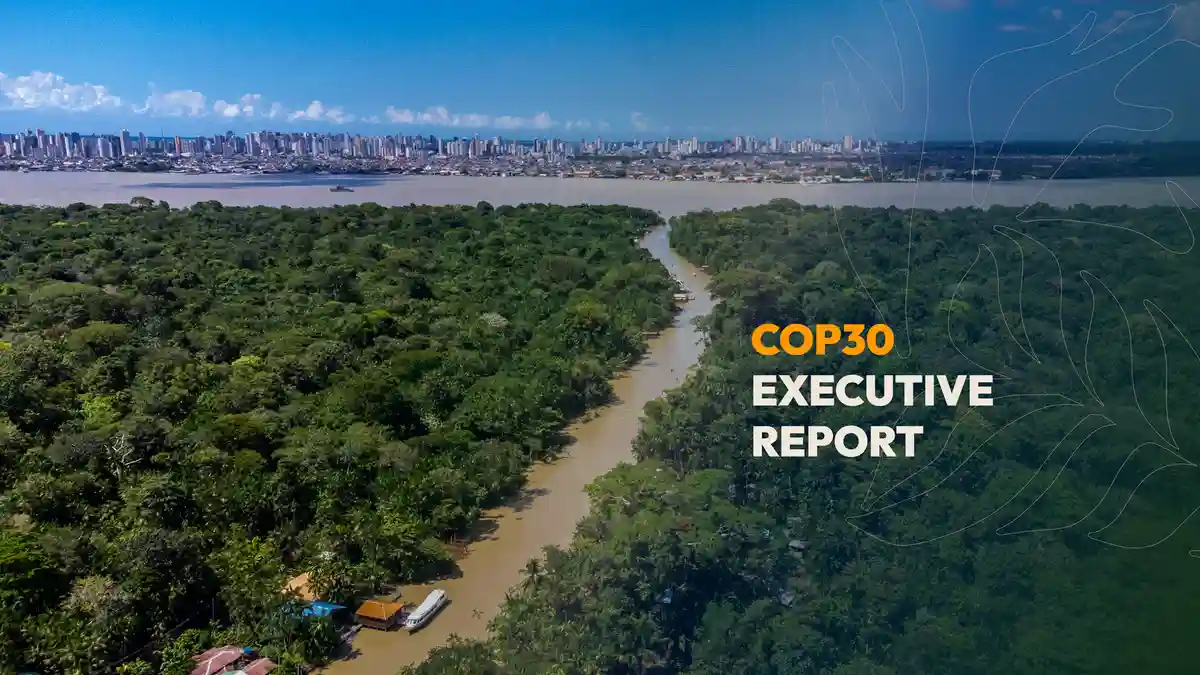
Image Credit: Alex Ferro/COP30