

Nescafé, Nestlé’s most prominent coffee brand and one of the world’s favourite coffees, outlined its extensive plan to help make coffee farming more sustainable: the Nescafé Plan 2030. The brand is working with coffee farmers to help them transition to regenerative agriculture while accelerating its decade of work under the Nescafé Plan.
The brand is investing over one billion Swiss francs by 2030 in the Nescafé Plan 2030. This investment builds on the existing Nescafé Plan as the brand expands its sustainability work. Nestlé’s regenerative agriculture financing supports it following the Group’s commitment to accelerate the transition to a regenerative food system and its ambition to achieve zero net greenhouse gas emissions.
“Climate change is putting coffee-growing areas under pressure. Building on 10 years’ experience of the Nescafé Plan, we’re accelerating our work to help tackle climate change and address social and economic challenges in the Nescafé value chains.”
David Rennie, Head of Nestlé Coffee Brands
Rising temperatures will reduce the area suitable for growing coffee by up to 50% by 2050. At the same time, around 125 million people depend on coffee for their livelihoods, and an estimated 80% of coffee-farming families live at or below the poverty line. Action is needed to ensure the long-term sustainability of coffee.
“As the world’s leading coffee brand, Nescafé aims to have a real impact on coffee farming globally. We want coffee farmers to thrive as much as we want coffee to have a positive impact on the environment. Our actions can help drive change throughout the coffee industry.”
Philipp Navratil, Head of Nestlé’s Coffee Strategic Business Unit
Supporting farmers’ transition to regenerative coffee farming
Regenerative agriculture is an approach to farming that aims to improve soil health and fertility and protect water resources and biodiversity. Healthier soils are more resilient to the impacts of climate change and can increase yields, helping improve farmers’ livelihoods.
Nescafé will provide farmers with training, technical assistance and high-yielding coffee plantlets to help them transition to regenerative coffee farming practices. Some examples of regenerative agriculture practices include the following:
- Planting cover crops helps to protect the soil. It also helps add biomass to the soil, increasing soil organic matter and thus soil carbon sequestration.
- Incorporating organic fertilizers contributes to soil fertility, which is essential for good soil health.
- Increasing the use of agroforestry and intercropping contributes to biodiversity preservation.
- Pruning existing coffee trees or replacing them with disease and climate-change-resistant varieties will help rejuvenate coffee plots and increase yields for farmers.
Focusing on origins from where Nescafé sources 90% of its coffee
Nescafé will work with coffee farmers to test, learn and assess the effectiveness of multiple regenerative agriculture practices. This will focus on seven key origins from which the brand sources 90% of its coffee: Brazil, Vietnam, Mexico, Colombia, Côte d’Ivoire, Indonesia and Honduras.
Nescafé aims to achieve:
- 100% responsibly sourced coffee by 2025
- 20% of coffee will be sourced from regenerative agricultural methods by 2025 and 50% by 2030 as part of Nestlé’s ambition for its key ingredients
Piloting a financial support scheme in Mexico, Côte d’Ivoire and Indonesia to accelerate the transition to regenerative agriculture
Nescafé is committed to supporting farmers who take on the risks and costs associated with the move to regenerative agriculture. It will provide programs to help farmers improve their income due to that transition. In Mexico, Côte d’Ivoire and Indonesia, Nescafé will pilot a financial support scheme to help farmers accelerate the transition to regenerative agriculture. Through this scheme, Nescafé and coffee farmers will test and learn the best approach in each country. These could include measures such as:
- conditional cash incentives for adopting regenerative agriculture practices
- income protection using weather insurance
- greater access to credit lines for farmers
Nescafé will track the progress and assess the results of its field programs with coffee farmers through its Monitoring and Evaluation partnership with the Rainforest Alliance. Its efforts will be complemented by new and expertise-focused partnerships, like the one with Sustainable Food Lab for topics related to coffee farmers’ income assessment, strategy and progress tracking.
Reducing greenhouse gas emissions also by capturing and storing more carbon in the soil
Regenerative agriculture also contributes to reducing carbon dioxide from the atmosphere and reducing greenhouse gas emissions. That’s why regenerative agriculture is vital to Nestlé’s Zero Net roadmaps. Nescafé aims to contribute to Nestlé’s Zero Net commitment to halve greenhouse gas emissions by 2030 and reach zero net greenhouse gas emissions by 2050. It will work with farmers, suppliers and partners to help protect agricultural lands, enhance biodiversity and help prevent deforestation. The brand intends to help farmers plant more than 20 million trees at or near their coffee farms.
Going forward by building on a solid foundation
Today’s announcement builds on Nescafé‘s sustainability efforts in coffee production. Since 2010, the brand has invested in sustainability through the Nescafé Plan and has made significant progress:
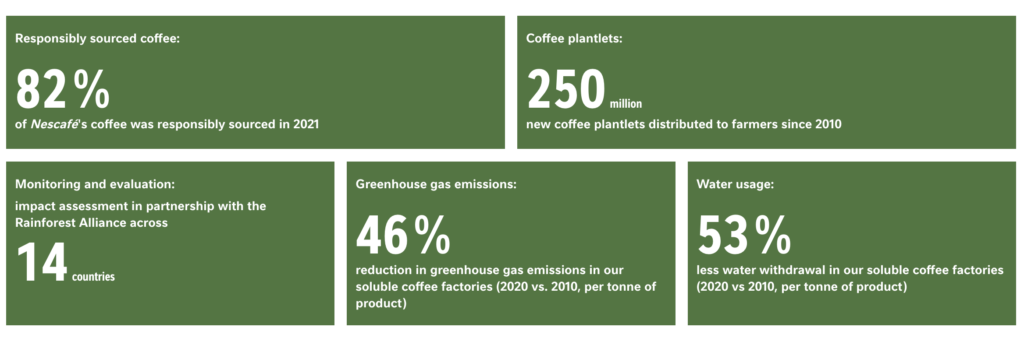
Source: Nestlé